Florida Storm Prep for Gutters in Hawthorne: What to Check Before Heavy Rain Arrives
When heavy rain sets in around Hawthorne, gutter problems stop being cosmetic and start becoming urgent. A small clog that seemed harmless in dry weather can turn into water spilling over the edge, soaking fascia, pooling near the house, and washing debris across the yard. In this part of Florida, that change can happen fast. Summer rainy season, tropical weather, thick humidity, and windblown debris all work together to test every weak point in a gutter system.
That is why storm prep for gutters is less about chasing perfection and more about removing the obvious failure points before the sky opens up. The basics matter most. Clear the debris. Make sure water can move from the roof to the gutters, through the downspouts, and away from the house. Check whether anything is loose, bent, or pulling away. If you have tall pines or live oaks nearby, pay even closer attention. Pine needles, oak leaves, and acorns are common troublemakers here, and they build up faster than many homeowners expect.
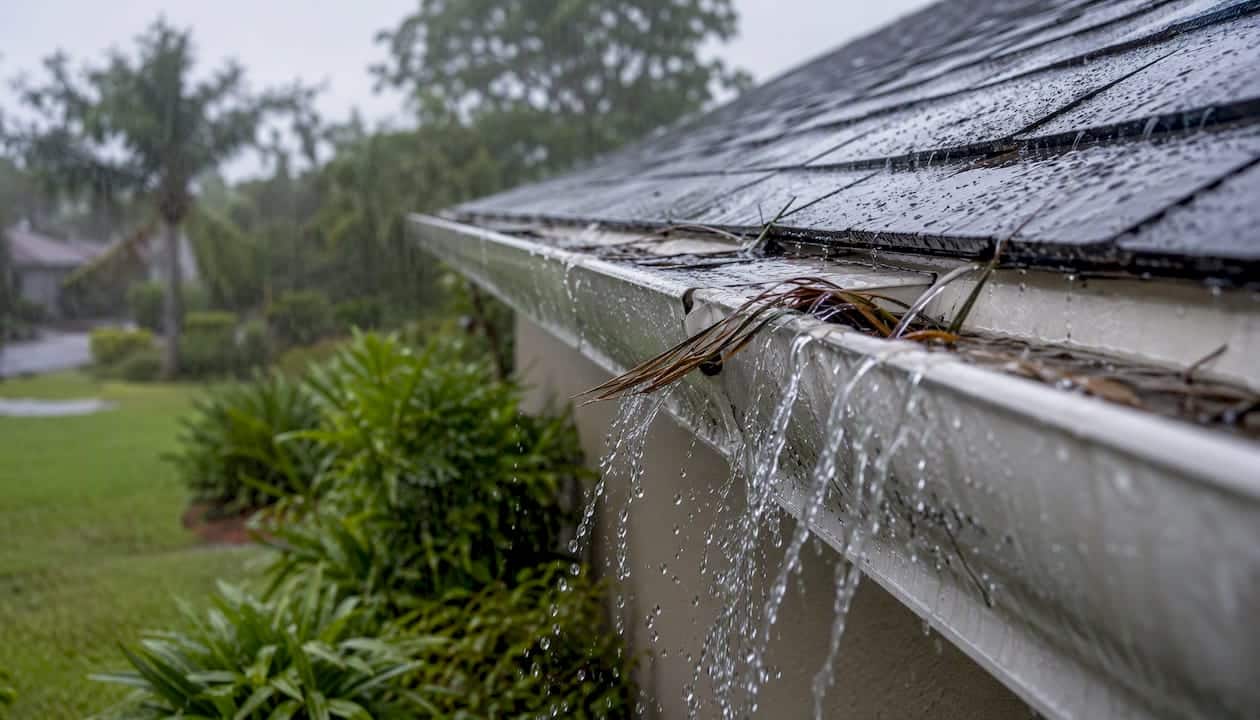
I have seen plenty of systems that looked fine from the driveway but were one hard rain away from overflow. The good news is that most storm-season issues reveal themselves if you know where to look.
What Florida weather does to a gutter system
Florida is hard on exterior materials even before a storm shows up. Constant moisture encourages organic buildup. Wind moves leaves and needles into every channel it can find. A few dry days can lull people into thinking the gutters are clear, then one storm sends a packed mat of debris toward the outlet and everything backs up at once.

UF/IFAS guidance for storm preparation specifically calls out the need to clear needles, leaves, and other debris from roofs and gutters. That lines up with what homeowners in and around Hawthorne, Gainesville, Newberry, Ocala, and Leesburg deal with every year. If a roof sheds oak leaves, acorns, or pine needles, the gutter system collects them. If the downspout outlet is already narrowed by buildup, the next rain exposes it immediately.
There is another piece many people miss. Debris that washes out of clogged gutters does not just disappear. Leaf litter and yard waste can move into drains and waterways. That is one reason it makes sense to remove debris before storms instead of waiting for runoff to carry it somewhere else. Pine needles and leaves are better handled on site, often as mulch in the landscape, than left to wash away.
Start at the roofline, not the ladder
A smart inspection begins with simple observation. Stand back from the house and look along the roof edge. If you can see saplings, weeds, dark streaks of decomposed leaves, or sections where the gutter appears to dip, you already know where to focus. The goal is not to diagnose everything from the ground, only to spot where water is likely to stall.
Then look at what surrounds the house. A home shaded by pines may need a very different maintenance rhythm from one in a newer subdivision with fewer mature trees. This is where broad online advice tends to fall short. Two homes on the same street can have completely different gutter demands based on tree cover, roof layout, and where downspouts discharge.
People searching for gutter cleaning Fruitland Park FL or gutter repair Wildwood FL are usually dealing with this exact issue. Storm prep is local. The debris load, the tree species, and the way water moves across the lot all matter.
The pre-storm check that catches most problems
If heavy rain is in the forecast, there are a handful of things worth checking first:
- Clear leaves, pine needles, acorns, and roof grit from gutters and downspouts.
- Look for sections that are loose, sagging, or separating at joints or corners.
- Make sure downspouts are open and able to discharge away from the house.
- Remove yard debris near storm drains and around downspout exits.
- Check that any gutter guards are not trapping compacted debris on top.
That list is simple on purpose. Most gutter failures during storms come down to blockage, poor flow, or loose attachment. Fancy accessories do not help much if the system is already packed with wet organic material.
Clogs rarely stay where you think they are
A lot of homeowners clean the visible trough and assume they are done. Sometimes that is enough. Often it is not. The hidden choke point is usually where water has to change direction or squeeze through a smaller opening. The downspout outlet is a common example. It can look clear from above while the vertical run holds a wad of needles, leaf pulp, or shingle grit lower down.
In areas where downspout drainage Newberry FL becomes a concern, the real issue is often not the downspout alone but the whole path water follows after it leaves the roof. If the gutter drains fine yet the outlet splashes right at the foundation or into a low spot, the system is still underperforming. Before heavy rain, check where each downspout sends water. You want discharge that moves runoff away from the house rather than concentrating it beside it.
This is also where homeowners sometimes discover a grading issue they had ignored in dry weather. Even without getting deep into site drainage design, it is obvious when a downspout empties into a place that stays muddy or scoured. Storm prep is the time to notice that, before repeated rain turns a minor annoyance into washout.
Why pine needles deserve their own conversation
Pine needles behave differently from broad leaves. They interlock, mat down, and slide into narrow spaces. Once wet, they can form a dense layer that sheds water across the top while trapping more debris underneath. In gutter systems, that means a little buildup can become a lot of buildup quickly.
That is why gutter guards for pine needles Florida deserves careful thought rather than a one-size-fits-all answer. Guards can help in some settings, but they are not self-cleaning by default. On homes surrounded by pines, I have seen guarded systems where needles formed a blanket over the top surface, reducing intake during heavy rain. I have also seen homes where the right guard noticeably cut maintenance. The difference usually comes down to the surrounding trees, roof pitch, how much wind-driven debris hits the house, and whether the homeowner still commits to periodic inspection.
The mistake is assuming a guard eliminates maintenance forever. In Florida, especially through wet season, organic buildup still needs attention. Even UF/IFAS maintenance guidance for stormwater systems stresses cleaning gutters and downspouts as needed and removing organic buildup, particularly in summer.
Gutters that pull loose before a storm are sending a clear warning
Fasteners and attachment points matter more than people realize. Florida code materials make clear that gutters and downspouts need to be securely fastened and built from approved materials, with corrosion-resistant fasteners. That is not bureaucratic fine print. It is practical storm advice.
A gutter full of water and debris is heavy. Add wind and repeated downpours, and weak attachment points show up fast. If one section has started to lean outward, overflow is only part of the problem. Water may slip behind the gutter instead of entering it cleanly, wetting the fascia or wall below. Before heavy rain arrives, look for nails or screws backing out, corners separating, or runs that no longer sit tight to the fascia line.
This is often the point when homeowners start weighing gutter repair Wildwood FL against a larger replacement. If the issue is isolated, a repair may make sense. If multiple sections are loose, corroded, or poorly aligned, patching one problem can leave three more waiting for the next storm.
Material and style choices matter, but they are not magic
Homeowners frequently ask about aluminum gutters Central Florida learn more and whether they are still a sensible choice. In practice, aluminum remains popular for good reasons, including its widespread use and suitability for exterior gutter work when installed correctly. The bigger lesson is that material alone does not make a system storm ready. Installation quality, fastening, slope, outlet design, and maintenance habits all matter.
The same goes for style. K-style gutters Lady Lake FL comes up often because many homes use that profile. It is common enough that people start talking about it as though the shape itself settles the issue. It does not. A well-installed system in the right size and layout will generally outperform a poorly installed one, no matter how attractive the profile looks from the curb.
When people ask about gutter sizes for Florida homes, I usually steer the conversation away from blanket answers. Florida code requires gutters and downspouts to be sized and discharged in accordance with applicable code, and that sizing depends on the home. Roof area, layout, and water volume all come into play. The right size for one roofline may be undersized for another. This is one area where guessing can cost more than asking a qualified contractor to assess it.
Seamless does not mean maintenance-free
Seamless gutters Ocala FL gets plenty of attention, and for understandable reasons. Reducing seams can reduce certain leak points. That can be a real advantage. But seamless systems still clog, still require cleaning, and still depend on solid attachment and proper discharge.
The practical value of a seamless gutter is often best understood this way: fewer joints may mean fewer opportunities for leakage along the run, but the system still succeeds or fails based on water flow. If the downspouts are blocked or the exits dump water in the wrong place, seamless construction will not rescue the situation.
I mention this because homeowners sometimes spend money on replacement thinking the new system will be self-managing. Gutter replacement Gainesville FL may be absolutely warranted if the existing setup is failing in multiple ways, but it should be paired with a realistic maintenance plan. Florida weather does not let any roof drainage system coast for long.
The ground below the downspout tells the truth
One of the quickest ways to judge performance is to inspect the soil and hard surfaces below each downspout. Staining, erosion, trenching, constant splash, and muddy pockets all point to concentrated runoff. If mulch keeps washing away from the same bed, or one corner of the house stays saturated long after rain, that is useful information.
This part of the check is especially important before a long rainy stretch. A downspout that discharges poorly in one storm can create a much larger mess after several days of repeated rain. That does not mean every issue needs a major redesign. Sometimes the immediate fix is simply to clear the path, remove the leaf pile packed around the outlet, and stop the water from hitting an obstruction right at the base.
It is easy to focus only on what is happening overhead because that is where the gutter sits. But storm ready gutters Florida depend just as much on what happens after the water leaves the downspout.
Signs it is time to call a pro instead of pushing your luck
Some storm prep jobs are straightforward. Others cross into repair or replacement work and should be handled by someone qualified. A good rule is this: if the system cannot carry and discharge water reliably after cleaning, it needs more than a quick tune-up.
Here are the cases where hiring a gutter contractor Florida makes sense:
- Repeated overflow happens even after the gutters and downspouts are cleared.
- Multiple sections are loose, sagging, or pulling away from the house.
- You see water getting behind the gutter or signs of leakage at several joints.
- Downspouts discharge in ways that repeatedly create washout or standing water.
- The system appears undersized or poorly laid out for the roof it serves.
This is also where local familiarity helps. A contractor who works regularly across places like Hawthorne, Gainesville, Ocala, Lady Lake, Newberry, Wildwood, and Fruitland Park is more likely to understand the mix of pine debris, oak litter, long wet stretches, and storm-season urgency that defines gutter work in this region.
What good storm prep looks like in practice
The best-prepared homes usually do not have the fanciest gutter systems. They have owners who pay attention before trouble starts. They clear roof edges and channels before debris gets waterlogged. They notice when a downspout exit starts to bury itself in leaf litter. They do not ignore the one corner that overflows every time it rains hard.
There is a practical rhythm to it. Before the wettest stretch of the year, clean and inspect. After the first strong storms, check again. If you have pines overhead, expect needles to keep coming. If you have oaks, watch for leaves and acorns collecting in valleys and outlets. If your yard crew leaves clippings and debris near downspouts or drains, move that material before the next downpour pushes it where it does not belong.
That habit matters not just for the house but for the broader drainage picture. Florida guidance consistently points to keeping leaf litter and yard debris out of gutters and storm drains, both to maintain flow and to reduce what gets washed into waterways. Good gutter maintenance and responsible yard cleanup are tied together more than people think.
The judgment call between cleaning, repair, and replacement
Most homeowners are not trying to become gutter experts. They just want to know whether they need a cleaning, a repair, or a full replacement. The answer often comes down to what happens after a proper cleaning.
If debris removal restores strong flow and the system is securely attached, you may simply need better maintenance timing. That is very common in tree-heavy neighborhoods. If cleaning helps but you still have leaks at corners, loose runs, or water slipping behind the gutter, repair is probably the next step. If the system has multiple chronic issues, poor discharge, recurring separation, and obvious age-related wear, replacement starts making more sense.
That is where terms like gutter replacement Gainesville FL or seamless gutters Ocala FL enter the conversation naturally. Not because newer always means better, but because there comes a point when stacked repairs cost more in frustration than a properly planned replacement would.

A final walk around before the rain starts
Before the forecast turns ugly, do one more slow walk around the house. Look up at the gutter line. Look down at the downspout exits. Look around the yard for loose debris that could wash into drains or pile up at outlets. If something looks marginal in dry weather, it will probably look worse in a hard storm.
Storm prep is not glamorous work. It is basic, hands-on, and easy to put off. But in Hawthorne, where heavy rain can arrive in bursts and keep coming, those routine checks can make the difference between a gutter system that handles the weather and one that fails at the first real test.
A storm-ready gutter system is not defined by marketing terms. It is defined by clear flow, secure attachment, sensible discharge, and regular upkeep. Get those four things right, and your house is in much better shape when the rain arrives.